
TEAMCARE Final Conference: From Pilot Implementation to Sustainable Adoption
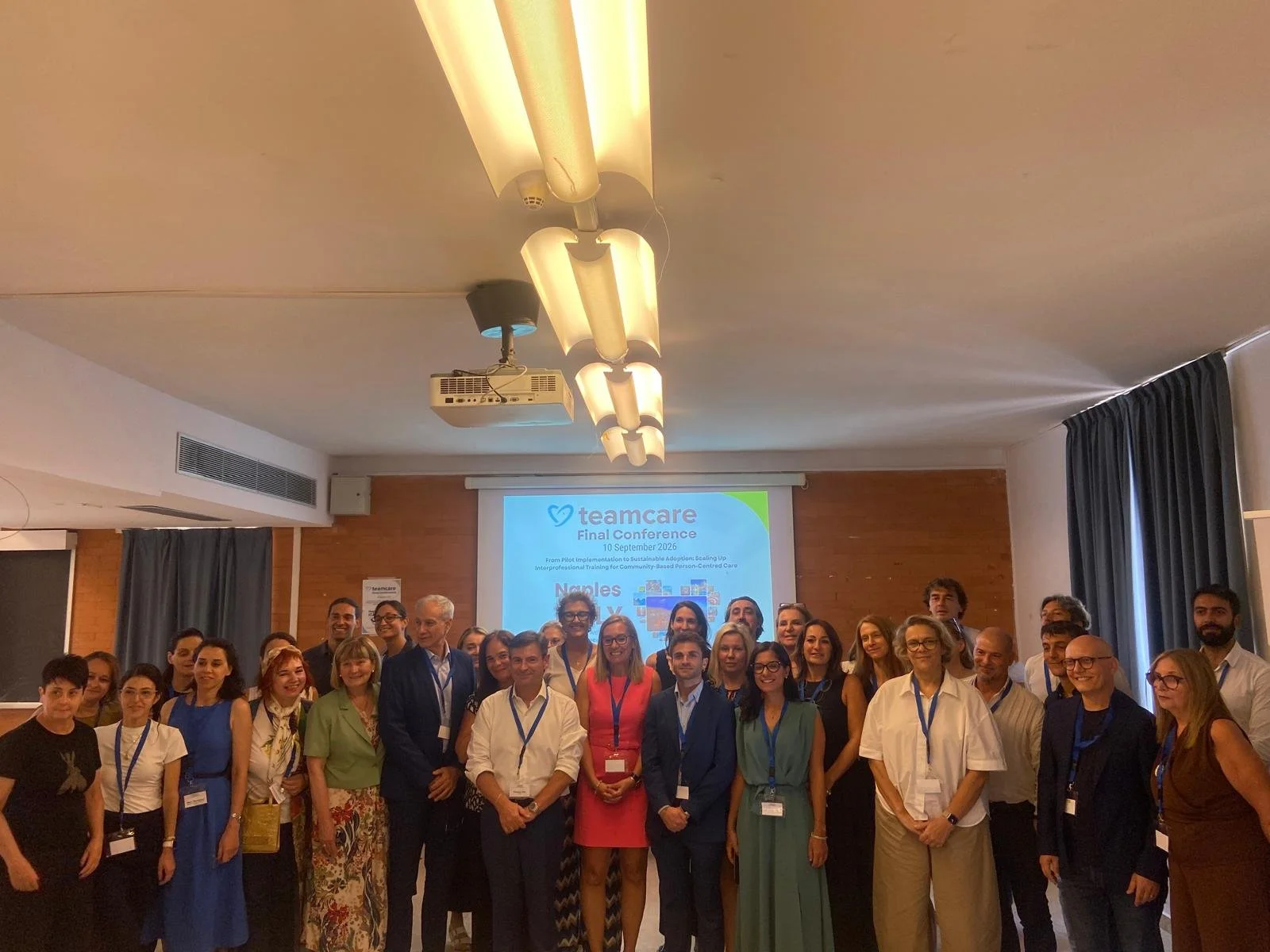
On 10 September 2026, the TEAMCARE community gathered in Naples for the project’s Final Conference, bringing together partners and external stakeholders to share the results of three years of collaboration and, above all, discuss how they can continue to be used beyond the project lifetime.
Hosted by the Department of Architecture of the University of Naples Federico II in hybrid format, the conference welcomed 105 participants from 12 countries, with 70 attending in person and 35 online. More than a closing event, it was designed as a space for dialogue and future collaboration, connecting TEAMCARE results with organisations, networks and professionals interested in their future adoption.
From a European competence framework to implementation in four countries
The conference presented the main components developed by TEAMCARE as an integrated training package for professionals working in community-based interprofessional teams.
At its core are the TEAMCARE Integrated Framework of Competences, comprising 58 competences across five areas, and the European Curriculum, with 59 learning outcomes organised into six modules. These are complemented by flexible micro-credentials, digital learning resources and practical tools that allow education and training providers to adapt TEAMCARE to their own contexts.
The experiences of the four pilots in Italy, Ireland, Greece and Poland showed why this flexibility matters. Overall, 180 professionals participated in the training, with feedback collected from 139 participants. Each pilot adapted TEAMCARE to its educational and healthcare setting while working towards common learning outcomes.
The pilots therefore provided more than a test of the training programme: they demonstrated how a shared European approach can be localised and implemented in different real-world settings.
Making TEAMCARE easier to adopt
A major focus of the conference was on what happens next. Participants explored practical resources designed to help new organisations use and adapt TEAMCARE, including the TEAMCARE Designers’ Kit, Course Design Tool and more than 80 learning resources available in four languages.
The importance of this practical dimension was confirmed by participant feedback: “Lessons from the four TEAMCARE pilots” and “Tools and guidance for adopting the TEAMCARE training package” were the sessions most frequently identified as useful, each selected by 70.6% of respondents.
Discussion then moved from tools to the wider conditions needed for adoption. Universities, health and social care organisations, public authorities and European and regional networks considered issues such as institutional readiness, leadership, interprofessional collaboration, faculty capacity, policy alignment and adaptation to local needs.
Particular attention was given to two mechanisms for continuing this work: the TEAMCARE Memorandum of Understanding (MoU) and Twinning Partnerships. The MoU provides a framework for continued engagement with TEAMCARE, while Twinning creates opportunities for organisations interested in adoption to learn directly from partners with implementation experience.
The TEAMCARE journey continues
The Final Conference also brought TEAMCARE into dialogue with a wider community from education and training, health and social care, research and innovation, public administration, professional organisations and European and regional networks.
Feedback showed strong support for this approach: across the conference outcome indicators, 88.2% to 94.1% of respondents agreed or strongly agreed that the event had helped them better understand TEAMCARE results and implementation experience, recognise adoption requirements and identify possible next steps.
The project has now created a European foundation for strengthening the competences needed for community-based, integrated and person-centred care, combining a common framework and curriculum with practical resources and experience from implementation in four countries.
The next challenge is to ensure that this knowledge continues to travel. Through the MoU, Twinning Partnerships, European and regional networks and future adopters, TEAMCARE can be adapted to new professional, institutional and regional contexts.
The funded project may be reaching its conclusion, but the community and resources it has created provide a foundation for the next phase: moving from project results to wider adoption, collaboration and sustainable change.